
Art O’Leary is chief executive of Ireland’s Electoral Commission (An Coimisiún Toghcháin in Irish). It is an independent body established just over three years ago.
He and I spoke on a panel together at the United Nations Development Programme-Elections Canada Global Conference on Responsible AI and Elections. After the conference, I followed up with him to learn about the two AI-related projects he talked about at the conference.
O’Leary said the commission started talking about AI about two years ago. It had no particular project in mind.
“We better find out what AI could possibly do, find out where the boundaries are and then see if we need to create some policies or safeguards,” he said, adding that the first conversations were about risk, with deepfakes topping the list of concerns. “The negatives outweighed the positives, to be absolutely honest, when we started thinking about this.”
Nevertheless, O’Leary and his team kept their eyes open, and all the while were considering positive use cases that could enhance efficiency.
One job did stand out as a candidate for help. Every census changes Ireland’s electoral map because the number of members of Parliament depends on population. Someone has to comb through the numbers first.
“There is such drudgery associated with the initial scan of populations in 166 local electoral areas,” he said. “There has to be a way of making this more simple.”
AI tools used
The commission has two AI projects in use. O’Leary calls both “live laboratory experiments.”
Drawing constituency maps with an algorithm from Harvard
Ireland’s constitution requires one member of Parliament for every 20,000 to 30,000 people, with the ratio kept consistent across the country. Constituencies have three, four or five seats. Mapmakers also weigh county boundaries, rivers, mountains and lakes, and they try to avoid unnecessary change.
“I always describe this process as a battle between maths and geography, and we want geography to win all the time,” O’Leary said. “But sometimes, the maths wins.”
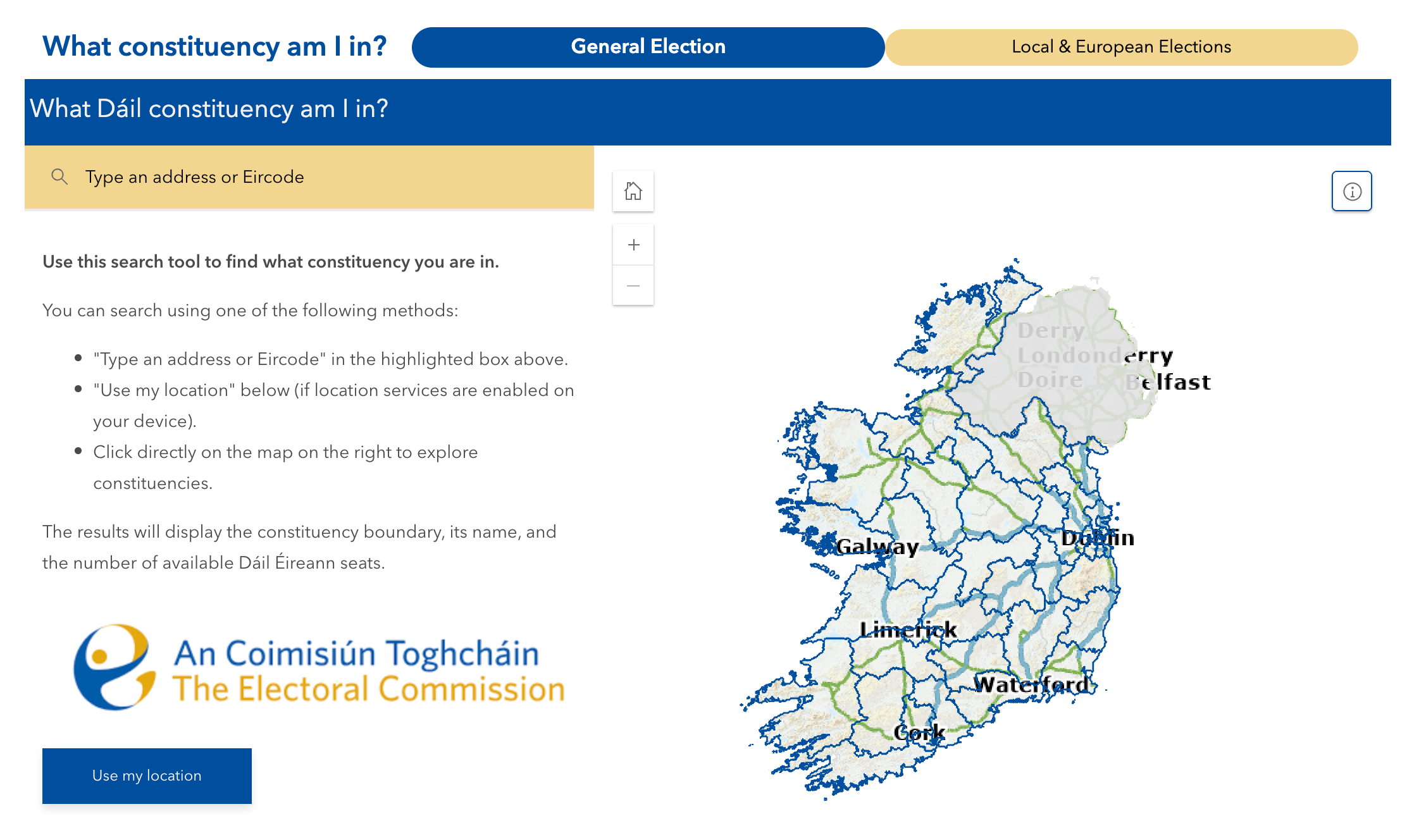
In 2023, two commission employees did the first pass by hand. They took census data on spreadsheets, printed maps and developed options. It took four months.
O’Leary then met a Harvard professor who had done redistricting work in the United States and Japan, both with single-seat districts. He asked whether the method could work with multi-seat constituencies. The professor said it had never occurred to him. A few months later, he came back with an answer.
The Harvard team’s algorithm produces a new map in 20 minutes. It can produce 10,000 maps in 20 minutes and rank them by whichever criteria the commission sets as a priority.
O’Leary gave the Harvard team the same data the two employees had used. The algorithm flagged the same three pinch points the manual review had found: one in County Kilkenny in the southeast, one in the far north and one in Dublin.
“They didn’t get everything right,” he said. “But the bit I was interested in, the bit that really captured my imagination, is that they pinpointed the difficulties much, much quicker than we were able to.”
The output is a set of options to consider and adjust. “There will never, ever be a situation where the AI gets to decide,” he said.
What changed is where the humans spend their time. The commission gets about nine months to complete a review. Four of those used to go to the initial scan. Now the team can rerun the model with different priorities, such as raising the weight on county boundaries, and see where the fault lines move. A separate live mapping tool lets decision makers adjust a boundary on screen and watch the population shift in real time. Previously, that meant ordering new printed maps and coming back the next week.
“We work [under] the gun here to a very tight deadline, and what it has given us is the luxury of time,” O’Leary said. “We get to the reflective and the deliberative piece much, much earlier in the process.”
Answering voter questions with a sandboxed chatbot
The commission’s website had a problem O’Leary said most election offices have and few notice. It has thousands of pages and how-to videos that run two or three minutes, yet visitors spend between 30 and 105 seconds on the site. Nine in 10 visitors arrive on a mobile device.
“These people don’t have the luxury of time,” he said. “They want to find something quickly, and the best way to do that is to ask a direct question.”
About 20% of Ireland’s population was born somewhere other than Ireland. The chatbot can converse in 122 languages.
The tool is sandboxed. It draws from only three websites: the commission’s own site, the National Election and Democracy Study site, and the Citizens Information Board, which O’Leary called the most trusted website in the country.
“In our chatbot’s world, there are only three places it goes,” he said. “Nothing else exists.”
The chatbot cost 8,000 euros to build. The website cost about 10 times that, O’Leary said.
When the chatbot goes live, the commission will let it run through the end of the year without adjustments, then conduct a formal evaluation. That review will look at traffic numbers and at the quality of answers. The commission plans to ask people who registered on the site whether they got the right answer.
O’Leary’s bigger worry is not the chatbot. It is that voters will ask a commercial AI tool instead. The communications team now has to market the chatbot as the trusted source, including QR codes in classrooms and community halls.
“We have to create a market for this,” he said. “We have to create an appetite.”
Policy and safeguards
The commission wrote its AI policy before it built anything. O’Leary said one comment at the conference stuck with him: AI adoption inside election management bodies is outpacing their ability to manage the risks and set up governance.
“People are starting to use AI in little bits and pieces without any umbrella framework,” he said. “That was our starting point.”
The policy rests on transparency. Employees may use the basic version of Microsoft Copilot, but they must declare it. Anyone who wants another tool has to present a business case and get sign-off from the IT team and the management team.
Disclosure is specific. An employee tells a line manager before using AI on a task. Any written work gets an asterisk and a footnote that explains exactly how AI was used, not just that it was used.
“I used AI for structure and language in this paper, but not the content,” O’Leary said, giving an example. “I did the research and I did the referencing myself.”
Using AI without saying so is a serious disciplinary matter. “It’s not illegal to use AI,” he said. “We encourage people to use it in certain circumstances, but you must be transparent.”
One area is off limits. The commission explains the meaning of referendums to voters, including what the country will look like under a yes vote and a no vote. That work requires the commission to be expert, impartial and independent.
“The risk of using AI is just much too great,” he said. “Particularly where there’s a legal interpretation of what the law means or what a constitutional change means, we’re never going there.”
As an almost brand new government entity, the commission approaches its knowledge management strategy very intentionally, and asks every employee to spend half a day a week learning. While thankfully not everything in the training repertoire is focused on AI, training on AI is mandatory.
“There is nobody who can dodge the AI bullet in our organization,” O’Leary said. “You may never use it, but you need to understand it.”
Both projects will get a formal, published evaluation. For redistricting, the commission wrote up the 2023 manual process at the time and will compare the two. O’Leary has promised to send the chatbot evaluation to UNDP for distribution to everyone who attended the Ottawa conference.
As for how the team took the changes, O’Leary said employees were relieved, particularly the ones who no longer face four months in a windowless room with a spreadsheet.
“It’s not quality,” he said. “It is efficiency that we’re looking at, and who doesn’t like that?”
Lessons for election offices
While no U.S. election office draws its own political districts, many are responsible for drawing or implementing precinct lines. Most run websites that voters abandon in under two minutes. O’Leary’s experience offers four lessons.
Write the policy first. The commission set its rules on approved tools, disclosure and red lines before it had a single project. “Governance and risk management is absolutely key here,” he said.
Pick the drudgery. Both projects started with a task people dreaded or a problem the data made obvious. The AI produced options for a human to weigh. “It is efficiency that we’re looking at,” O’Leary said.
Fence the tool. The chatbot can only see three websites. Nothing else exists to it. Restrict the sources, then try to break it before voters do.
Consider disclosing how and what. A label that says AI was used is not enough. The footnote should say what the tool did and what the person did.
O’Leary’s last point was about sharing. He plans to publish both evaluations.
“AI doesn’t recognize any borders either,” he said. “We should all be learning from each other rather than having to reinvent the wheel all the time.”
Originally posted on the AI and Elections Substack, October 16, 2026. Read the original ↗