
Before I jump in, a few updates:
Congratulations to Michael Moore and Tonya Wichman, both AI + Elections Clinic Advisory Council members, who were recently named fellows in the McCain Institute’s 2026 American Democracy and Technology Fellowship.
We have two upcoming AI + Elections Clinic Bootcamps: April 7 in Atlanta and May 6 in Chicago. Election officials interested in attending can email [email protected] for more information. There is no cost to attend, though the Clinic is unable to cover travel expenses.
I’m now with Ready for Tuesday, a new organization focused on resilience, readiness and capacity-building for election officials and organizations that support election officials.
The AI + Elections Clinic is also available for presentations at election conferences. To inquire about scheduling, email [email protected].
So, with all that in mind, on to the practical part.
The U.S. Election Assistance Commission recently released AI in Action: Case Studies for Election Officials.
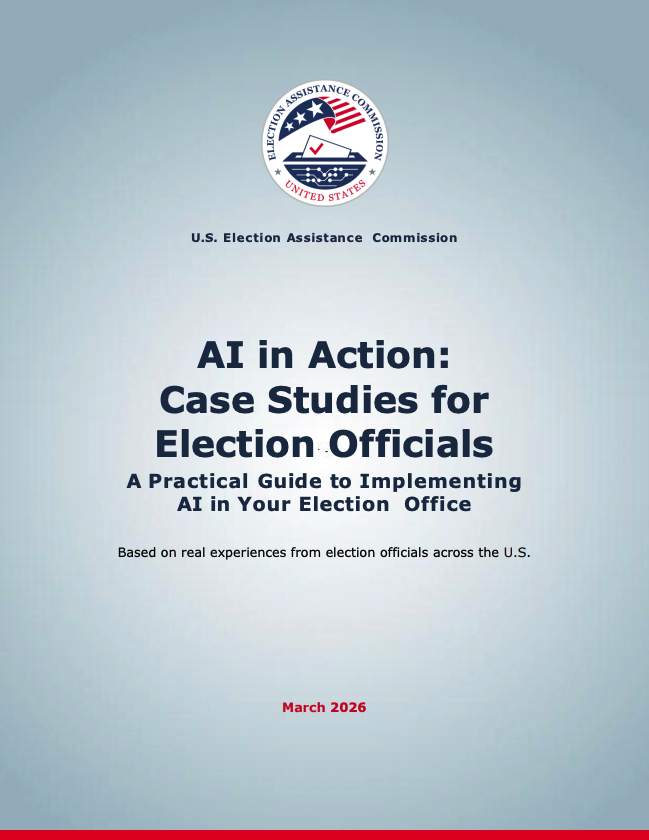
Some examples of use cases from the guide:
Getting past the blank page
Staff used AI to draft a year-long social media calendar, then edited for accuracy and tone. It didn’t replace the work — it just made starting easier.
Helping with scheduling (not solving it)
One office used AI to generate poll worker assignments based on constraints like skills and location. It took multiple iterations and still needed human judgment.
Thinking through turnout
Instead of guessing, an office used AI to help structure a turnout forecasting approach using past elections. The office tested it before relying on it.
Note: This is very similar to what Gretchen Reinemeyer talked about doing in an AI + Elections Clinic post last year.
Summarizing meetings
AI helped turn recordings into summaries and action items. It saved time, but still required careful review for errors and misheard details.
Making training usable
Staff used AI to turn dense manuals into role-specific training modules and quick-reference materials, with final verification by humans.
These are small use cases, but they add up.
And they’re a good reminder that most of the impact isn’t coming from big, sweeping changes. It’s coming from making everyday work a little easier to start, a little faster to move through, and a little more consistent.
Originally posted on the AI and Elections Substack, March 25, 2026. Read the original ↗