
Building a custom tool used to take years and a sizable, expensive development team. AI coding tools have changed the math. Now a small group with a clear idea can do it in weeks or months. The old saying asks whether the juice is worth the squeeze. Today, the squeeze is smaller and the juice is better.
That shift is already showing up in practical tools for election administration. Joann Bautista and Will Adler from the Bipartisan Policy Center created and released a tool designed to make legislative tracking easier for election officials – or any team!
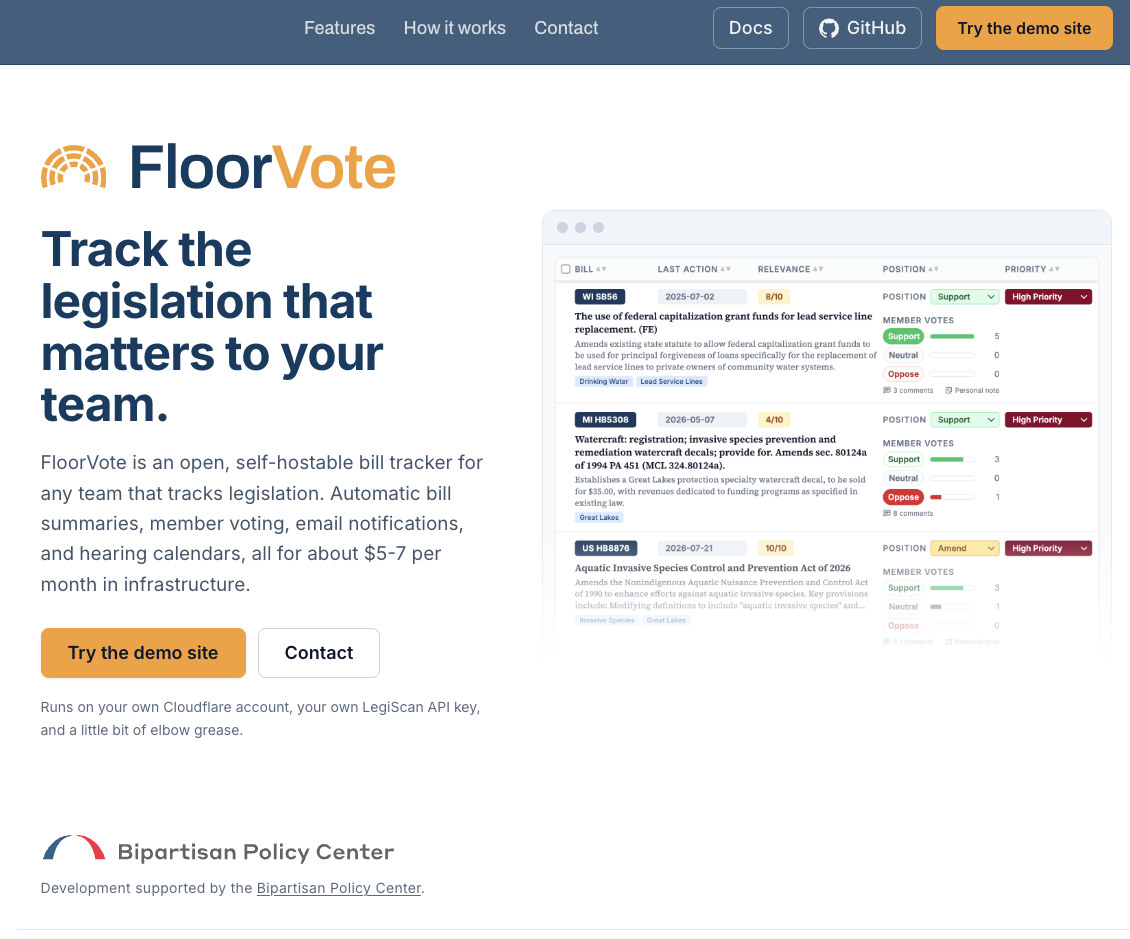
FloorVote is a free, independent, open-source platform that allows state election official associations to track state legislation in one place. The site leverages AI to create plain language summaries of each bill’s content and flag legislation based on a team’s chosen search terms, such as “county clerk.” FloorVote also supports collaborative review and decision-making by allowing members to comment, tag one another, and receive notifications.
Why does this matter to election officials?
For election officials, changes in policy can result in changes to operations, and with elections, legal compliance is critical. A service like FloorVote makes it easier for officials to track and respond to bills that affect them. Time and staff capacity can become increasingly constrained, especially as elections approach. In many states, this type of tracking is a function managed at least in part by the election official association. Using a shared platform that simplifies the legislative tracking process can reduce the burden on overburdened offices and make it easier for association members to collaborate.
FloorVote also presents a practical use of artificial intelligence through its generative summaries for pieces of legislation. Understanding a bill in plain language not only improves internal communications but also strengthens public messaging. Rather than dedicating hours for tracking and interpreting legislation, an office can shift its focus to understanding the core implications and how those changes should be presented to the public.
Time saved on tracking and responding to bills means that election officials have more time to do what they do best: running a good election.
Originally posted on the AI and Elections Substack, October 6, 2026. Read the original ↗