
A few months ago, a friend who also happens to be a highly respected election administrator posed a really good question: What should election offices do about AI glasses?
We’re talking about smart glasses, like those made by Meta and other companies, that allow people to take pictures, record videos, and interact with AI without pulling out a phone. What happens when voters, observers, or others wear these devices into polling places or ballot processing centers?
Both of us remember the ballot selfie craze of the 2010s, when election administrators were confronted with questions about voters taking pictures of themselves with their completed ballots.
In Florida, for example, state law restricts photography inside polling places, with an exception enacted in 2019 for voters photographing their own ballots.
Illinois offers a different example. State law prohibits voters from allowing others to observe how they mark their ballots, but a 2017 court ruling found the restriction on ballot selfies unconstitutional. As a result, the National Conference of State Legislatures (NCSL) considers ballot selfies likely permitted in Illinois.
These laws weren’t necessarily written with ballot selfies in mind, but there are good reasons to be concerned about voters photographing their completed ballots.
Ballot secrecy is a foundational piece of our election system. It’s not hard to imagine the ways voters could be manipulated, pressured, or extorted based on a picture they’ve taken of their completed ballot.
That brings us back to AI glasses.
A familiar issue, with a new twist
AI glasses don’t necessarily introduce an entirely new problem for election administrators. Election offices have been dealing with cameras, smartphones, and recording devices for years.
What makes these glasses different is the ease with which people can record, and how much less obvious that recording might be.
Unlike someone holding up a smartphone or pointing a camera, someone wearing smart glasses can take pictures or record video without drawing much attention. Many look like ordinary glasses, including frames from Ray-Ban, Oakley, and Warby Parker.
Current mainstream models have recording lights, but they’re small and easy to miss. On some models, those lights can be disabled or covered. Some devices can also livestream video, capture audio, or provide real-time transcription and translation.
That introduces or exacerbates many of the same problems election administrators have been contending with for years, while creating some new challenges.
What should election offices do?
The Election Security Exchange recently published a resource, AI Glasses in the Election Office, examining what existing rules may cover and what’s actually new.
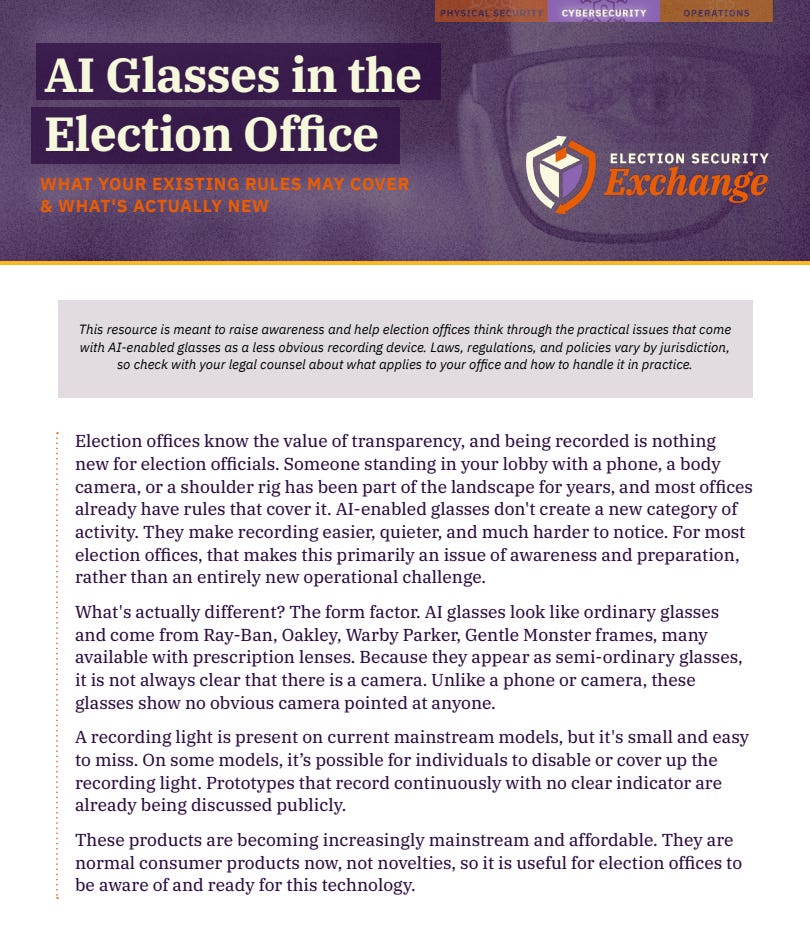
The resource offers several practical steps for election offices to consider:
Review existing policies regarding cameras, photography, cell phones, and recording devices in polling places and other election facilities. Consider whether the language clearly addresses camera- and microphone-equipped smart glasses or whether updates may be needed.
Assume you may be recorded. Treat public interactions as if they’re on camera, and remain professional and calm.
Train staff and poll workers to recognize the devices. Show examples of smart glasses and explain their basic capabilities. The goal is consistent application of existing rules, not confrontation.
Don’t rely on a recording light. Some devices can be modified to allow covert or hard-to-detect recording.
Review policies for staff and poll workers. Consider whether existing workplace or Election Day policies address employees wearing these devices while working.
Post clear signage about recording in restricted areas, and focus on applying policies consistently.
The resource also raises questions about audio recording, since state laws vary on when consent is required. Rather than expecting pollworkers to resolve complicated legal questions in the moment, election offices should identify likely scenarios in advance and consult with legal counsel.
Like many things election administrators deal with, this is an issue that benefits from awareness and preparation.
That doesn’t necessarily mean every election office needs a new policy specifically addressing AI glasses. Existing rules may already cover these activities. But election officials should understand what these devices can do and how their existing policies apply.
Of course, whether these glasses present a particular issue also depends on state law. NCSL maintains a useful state-by-state overview of ballot secrecy and ballot selfie laws. Some states allow voters to photograph their own ballots, others prohibit it, and some restrict cameras or recording devices in polling places more broadly.
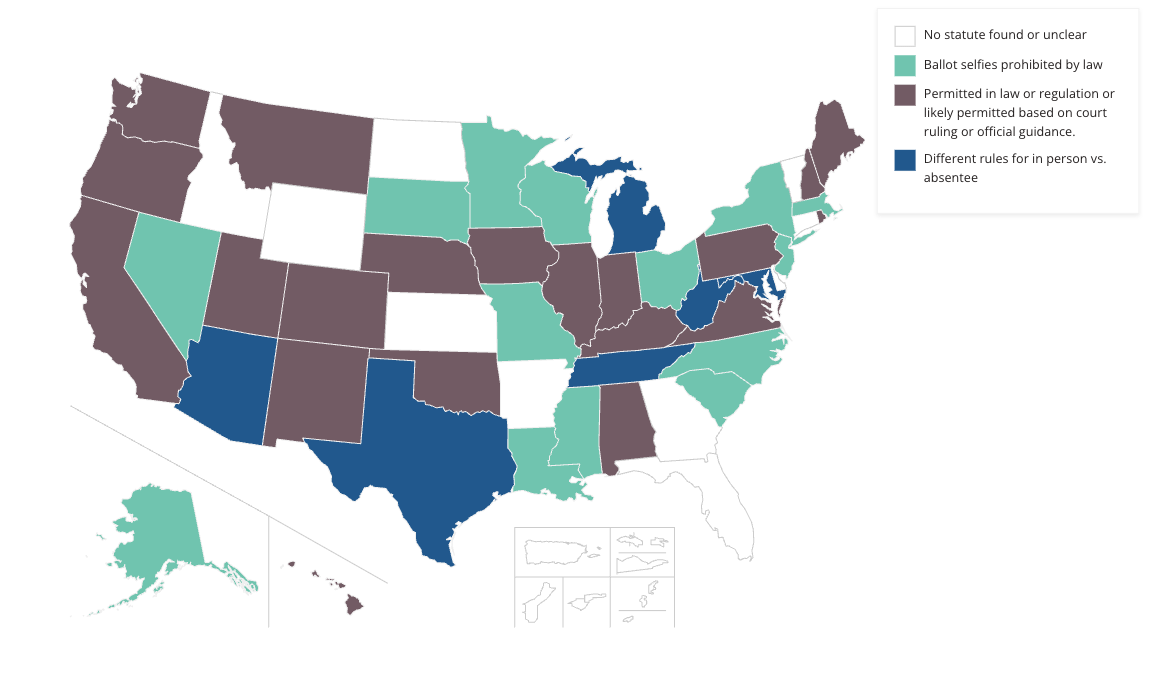
As with so many technological advances we’re seeing, dealing with, and in some cases benefiting from, AI glasses are no different. They require awareness and a willingness to think through how new technology interacts with existing election practices.
We don’t think the answer is necessarily to prohibit the technology or assume everyone wearing these glasses has bad intentions. But it makes sense to consider the implications before someone walks into a polling place wearing them.
We’re particularly interested in how jurisdictions are approaching this. Have you developed a policy addressing smart glasses or other wearable recording devices? Have you updated an existing photography policy? Or have you decided your current rules are sufficient?
If your office has a policy or has been thinking through this issue, we’d love to hear about it. Email us at [email protected]. Better yet, if you have something in writing you’re willing to share, please send it along. We think there’s real value in seeing how different election offices are approaching this technology.
Originally posted on the AI and Elections Substack, October 21, 2026. Read the original ↗