
Editor’s Note: If your office is considering responsible, constrained AI tools to support election operations, we’d welcome a conversation. Reach out to share what you’re testing or to explore how an Eva-like system could work in your environment.
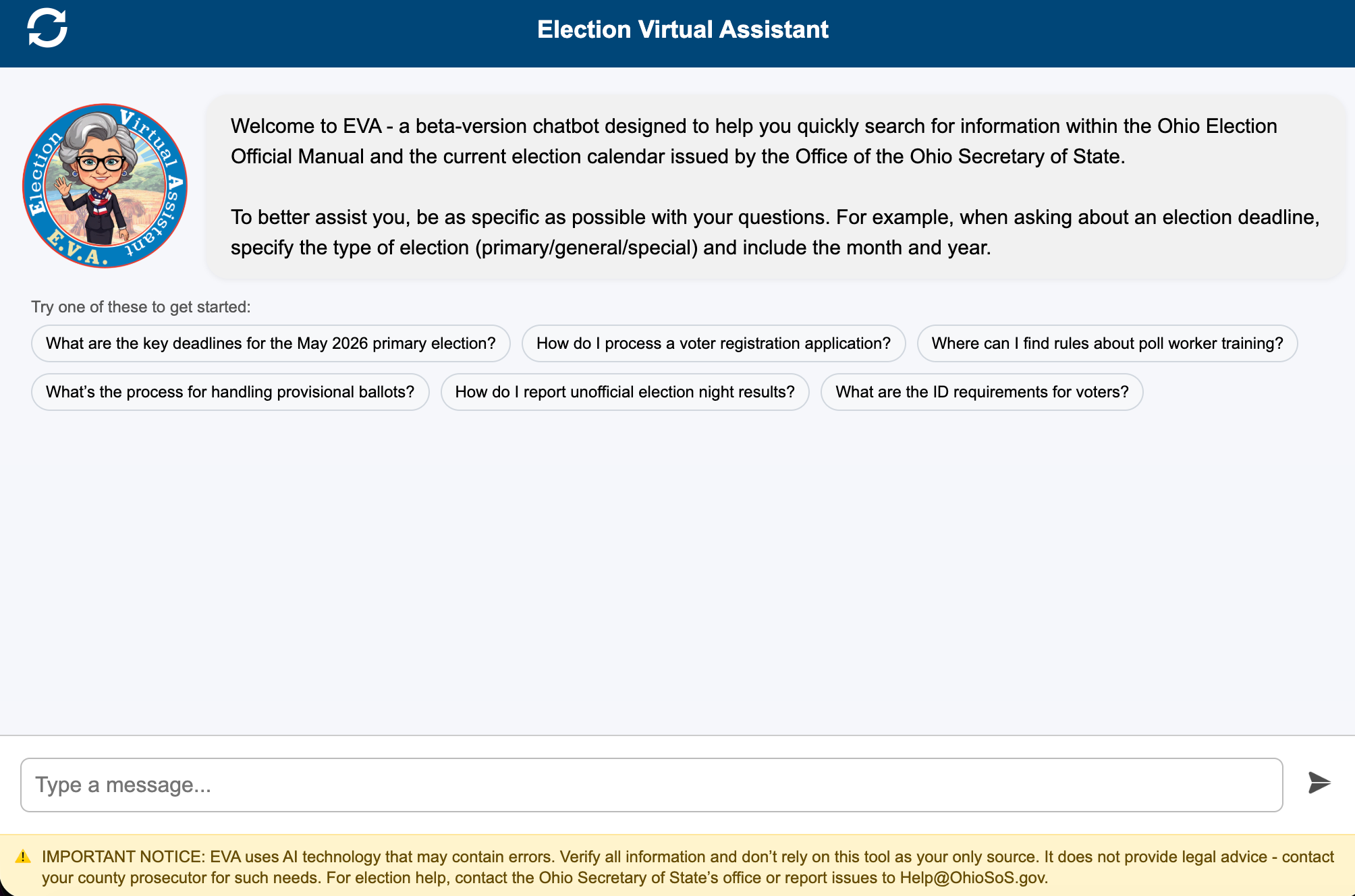
Every so often, a project emerges that reframes how we approach the basic blocking and tackling of election operations. Recently, we had the chance to speak with the team at the Ohio Secretary of State’s Office about one of those efforts: an internal tool called Eva, short for Elections Virtual Assistant.
Eva is not a public-facing chatbot or a wholesale modernization initiative. Instead, it is a deliberately narrow solution to a familiar operational challenge – what happens when critical knowledge is technically available but practically inaccessible because it is buried in hundreds of pages of documentation.
Like many states, Ohio relies on a comprehensive Election Official Manual that serves as the authoritative source for procedures, policies and legal guidance. At more than 500 pages, the manual is thorough and essential, but it is also dense, legalistic and time-consuming to navigate under pressure.
When a county official needs an answer to a specific procedural question early on Election Day – perhaps about recount thresholds or voter identification requirements – their options have traditionally involved searching through the lengthy PDF or waiting in a queue to speak with someone at the state. Neither approach is ideal when decisions need to be made quickly and voters are already arriving.
Rather than continuing to refine the document alone, the Ohio team asked a more fundamental question: Instead of simply making the book easier to read, could they make it easier to ask?
Working within their existing Azure public cloud environment, they deployed a large language model configured with tight guardrails and a limited knowledge base. Using a retrieval-based approach, Eva draws its answers exclusively from two trusted sources( the Election Official Manual and the state’s annual election calendar) and provides responses that cite the specific sections from which the information is drawn. In practice, this means that a team member can ask a plain-language question and receive a concise, source-grounded answer in seconds, without needing to manually locate the relevant page.
What stands out about this project is not the technology itself, but the clarity of the problem it is designed to solve. Too many public-sector AI initiatives begin with a tool and search for a use case. This one began with a workflow bottleneck that nearly every election office recognizes: experienced staff spending valuable time answering the same foundational questions or searching for information they already know exists somewhere in a manual.
By handling those routine, “level one” inquiries, Eva effectively clears space for higher-value work. Legal and policy staff can focus their time on complex or judgment-heavy issues rather than repeatedly pointing callers to page numbers. The result is not a reduction in expertise, but a better allocation of it.
The economics reinforce that point. The primary investment has been staff time and configuration rather than large technology contracts, and the computing costs for early testing were minimal. For a relatively small effort, the team has meaningfully improved response times and reduced internal friction across 88 counties.
There are a few practical lessons here for other offices considering similar approaches. First, the most promising opportunities are often found where information already exists but is difficult to access – dense manuals, sprawling FAQs, or legacy knowledge bases that staff rely on but struggle to navigate. Second, constraints can be an asset rather than a limitation. By restricting the system to approved internal documents rather than the open internet, the team increased both reliability and trust. Finally, positioning the tool as an assistant rather than an authority has helped set appropriate expectations. Eva supports decision-making; it does not replace the experience and judgment of election officials.
Ultimately, the story of Eva is less about artificial intelligence and more about operational design. It reflects a simple but important premise: the people running elections should spend as little time as possible searching for information and as much time as possible applying their expertise.
If AI has a durable role to play in election administration, it will likely look like this – focused, constrained, and embedded directly in the everyday mechanics of the work. Ohio’s approach offers a useful reminder that meaningful innovation in our field is often modest in scope, practical in intent, and aimed squarely at making it easier for professionals to do their jobs well.
Originally posted on the AI and Elections Substack, March 2, 2026. Read the original ↗