
Ten years ago, a foreign adversary owned part of Illinois’ online voter database. It was an inflection point that ushered in an era of security awareness and cooperation. Election officials rallied to meet new challenges. Today feels very similar. We are at another galvanizing moment where the technology security community warns that the ground under our software has shifted. Frontier AI tools have sharply accelerated vulnerability discovery in some software finding flaws in code faster than humans. Foreign governments, criminal groups, and domestic troublemakers have a new capacity to find a way into many systems. And not just in those that are old, unpatched, or forgotten, but also in new tools built without using secure-by-design principles.
Chris Krebs, one of our community's trusted voices, says the next 12 to 18 months will be bumpy, and to prepare for a 72-hour emergency loss of services, with cash on hand, and important information on paper. We should prepare for technology disruptions as we do for earthquakes or hurricanes. For tech infrastructure it’s gonna get worse before it gets better. We stay calm, but we do the work to mitigate such disruptions.
Election tech is certainly not immune. It includes voter registration and election management systems; electronic pollbooks; websites with voter tools and public information; results reporting; ballot printing and mail ballot processing; and the county networks, email, and phones that hold all of it together.
Most of it runs on the same business products, operating systems, cloud services, and software libraries as every other part of government and industry. And government tech is not always on the leading edge of up-to-date system security.
This is not our first rodeo of course; we have faced something similar. A race against the clock where defenders felt out gunned. Twenty-seven years ago there was a defect buried in computer systems across the world, and there was a real chance of widespread failure. You remember Y2K. How we got through it can guide what we do over the next two years.
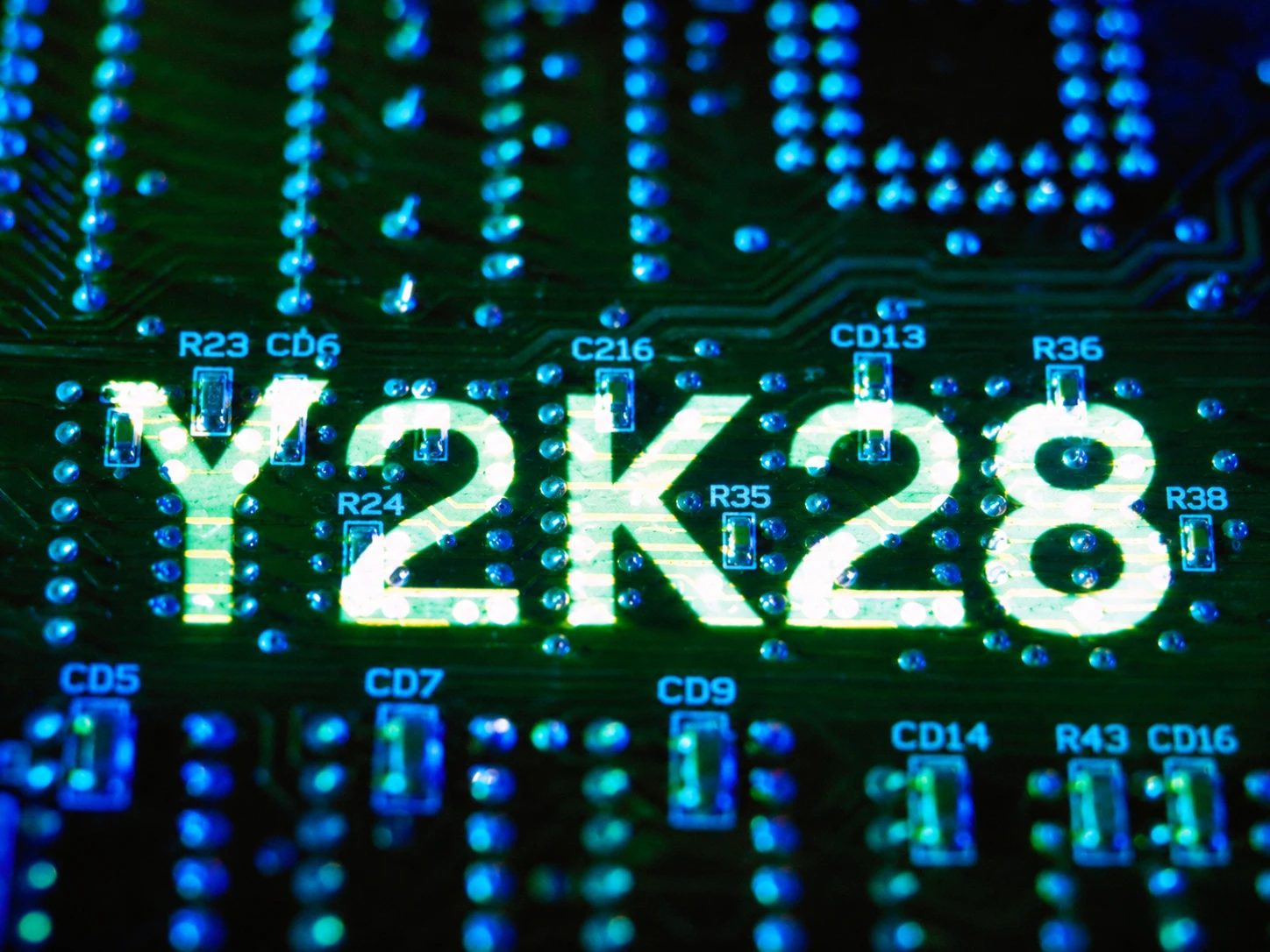
Then we had a fixed deadline and a common class of date-related bugs. Today, we don’t know all the vulnerabilities. But in elections we have a deadline that does not move. The next presidential general election is November 7, 2028. For the next 12 to 18 months the network defenders will be at a disadvantage. Let's make Election Day 2028 our generation's Y2K, and rally our resources for this effort: Y2K28.
What Y2K Taught Us
For those who remember, Y2K was an overblown scare to many. The clocks turned over, the lights stayed on, and the late-night comedians had fun. Despite widespread angst, critical services kept running with limited disruptions. But nothing significant happened that night because an enormous amount of work happened first. Federal agencies alone estimated they would spend roughly $8 billion on fixes between 1996 and 2000. Major banks worked on the problem for years. John Koskinen, who chaired the President's Council on Year 2000 Conversion, said afterward that the quiet rollover showed the work had succeeded, not that the problem had been imaginary.
Our lessons should include the several things that made it work. The date bug was a threat to the core mission; it was not just one more technology request. The federal government acted mainly as a catalyst; it organized working groups in every sector and banking regulators set readiness standards. Congress passed the Year 2000 Information and Readiness Disclosure Act providing legal protection to organizations that shared readiness information in good faith. The fear of lawsuits did not keep organizations quiet. The public was kept informed along the way. Preparation did not turn into panic.
Organizations and institutions invested early and together. Those that waited suffered. Large systems take too long to fix at the last minute.
What Is Different This Time
Y2K was comparatively easy. It was mostly one problem with one deadline. The challenge in front of us is much more difficult. A perpetual race across an infinite valley. And yet, there are so many parallels.
Until recently the pace of security was set by how quickly flaws could be found. That has flipped. In 2015, DHS required federal agencies to remediate specified critical vulnerabilities on internet-facing systems within 30 days. CISA's 2026 directive gives federal civilian agencies as little as three days to address the highest-risk vulnerabilities. This spring, a coalition of technology companies working with a frontier AI lab reported finding more than 10,000 high- or critical-severity vulnerabilities in the world's most important software in a single month, and several partners said their rate of discovery had jumped more than tenfold. Finding flaws is now the easy part. The hard part is verifying, disclosing, and patching bugs. Some vendors are releasing more fixes, while organizations are taking a bit longer to deploy them for known exploited vulnerabilities.
That makes old technology our soft underbelly. Unsupported operating systems, aging servers, and custom code written years ago are dangerous because the flaws are so cheap to find. The age of a system is now a security decision.
On the good side, the same tools help defenders. AI lets offices modernize, test, and harden systems that were too costly to touch a few years ago. Used with discipline and good governance, it may be the best defensive tool we have. The question is whether we can deploy these tools more quickly and more effectively than our adversaries put them to work against us.
Election officials know we are not alone in this. Banks, hospitals, water utilities, and every government body faces the same race. We are one part of a much larger ecosystem, and we will only be as safe as the systems we depend on.
The Missing Convener
In the runup to Y2K, Washington could convene stakeholders because they were trusted to do so. Today the agency built for that technology security job is not positioned to support election officials.
CISA was created in 2018. Over the following years it earned something rare: election officials came to trust it enough to accept its help, and then to defend it in public. CISA sent people into our offices, assessed our systems, and connected us to threat information we could not get on our own.
That trust has been diminished. In 2025 the agency halted much of its election security work. Some election technology vendors pulled back from sharing sensitive information with CISA, citing concerns about confidentiality. Election officials said their own governments had not filled the gap. Many no longer trust the federal partners they once relied on.
CISA has tried to re-engage. I hope it succeeds. But trust takes years to rebuild, and we do not have years.
That is the tragedy of this moment. Just when election officials most need a trusted national convener, the one we built is not situated for the task. The work then falls instead to the states, to industry, and to the networks officials have built among themselves. The fragmentation of 50 states and thousands of local offices, each moving at its own pace, without common milestones or a single place to share what we find, makes this an immense problem. In a race like this one, fragmentation is a vulnerability all its own.
What Has to Happen
There is no single fix here. There is no single solution that fits every office. Broadly, there are three buckets of work. Each bucket is expensive and time consuming. But waiting will cost more.
Move Fast and Invest in the Old
Straight from the CIS controls or the NIST cybersecurity framework, start with an inventory. Every office should know what it runs, who supports it, how old it is, and when it was last patched. This is simple enough on paper, though it's difficult to fully finish the job. It was the first lesson from Y2K modernization.
Simple risk management would suggest you must prioritize internet-facing and internet-connected systems first, given the different exposures and threat surface areas.
- Update what has been lagging for whatever reason. If a system is still supported it should receive its security patches immediately. Perform acceptance testing and deploy. Of course certified voting systems come with different risks and requirements to stay in compliance.
- Next deal with what can't be patched. End-of-life hardware and software really have to be retired or walled off, and the money to do it has to be requested now, in this budget cycle, not the next one. (There is a critical interplay here with code generation tools that make replacement, done safely, securely and sustainably, so much easier than ever.)
- Speed matters. Critical patches cannot sit for months.
- Where offices use AI to rebuild their own tools (and many will, because it is finally affordable), the building has to happen under real governance, with security review, and well away from an election. All of it belongs in 2027. Primaries begin in early 2028, and nobody should be swapping out systems with voters at the door.
Pay Attention and Share What We Know
Election officials don't need to be security engineers. They do need to ask the right questions and make sure someone owns each answer. Vendors deserve special attention. A small number of companies supply technology to thousands of jurisdictions, which means one flaw can reach all of them at once. Vendors should be scanning their own products with modern tools right now, shortening their patch cycles, and telling customers plainly what they find. Election officials should ask. Directly. And they should expect a real answer. AI Companies should be providing those tools!
Information sharing has to get faster, too. Another impact from the CISA retreat, and defunding of the ISAC. But when one office or vendor finds a flaw, every office running that product should know. Information should spread quickly and in plain language. When one county gets probed, its neighbors should hear quickly. Organizations can still lean into MS-ISAC, or what CISA provides. But new channels need to be created that are built for the speed of now.
Information flow also has to reach beyond elections, because what a hospital learns about a shared software library this week may matter to a county clerk next week. We should share solutions, not just warnings. Thousands of jurisdictions cannot each solve the same problem from scratch.
Build Analog Resilience
This has been true from the beginning. And the holy grail of election security is tactile.
Today, more than ever, paper is providence. We will not patch every flaw in time. Nobody will. New models may find new flaws. Keeping up is a boundless undertaking. So the real goal is an election that holds even when the technology doesn't.
We have a head start. Most Americans vote on paper, and audits check reported results against that paper. These were hard-won policy choices made over the last decade and worth more today than when we made them.
The task now is to seriously carry that logic and thinking into every other system. This is all probabilities. If it's more likely than ever that a digital system is breached, then our risk management dictates we mitigate. If the electronic pollbook goes down, can we still check voters in? If the registration system is unreachable, is there a current offline copy? If results reporting is knocked out, can we still count, verify, and announce accurately, if more slowly? If email and phones fail on Election Day, how do we reach our polling places? How do they reach us? And what about the voters?
Each procedure should be written down, taught to staff, and rehearsed. Theory is only theory. Practice makes it real.
And when something does go wrong (something will), the strongest message an election official can deliver is a simple one: we planned for this, the election is still running, and every valid vote will be counted.
Who Will Pick Up the Flag
If Washington cannot lead this effort, someone else must. It falls to us. “Us" is larger than it may appear.
Election officials, the vendors, and the people who work in the periphery know this ecosystem better than anyone. None of us needs permission to begin this conversation, to begin this work. Vendors should go first; a fix from one of them reaches thousands of offices at once.
Next, a bipartisan collection of state leaders. Secretaries of state, state election directors, or their ilk, from both parties can work together to set common readiness milestones and hold one another to them. A commitment made across party lines, in this time of deep rancor and angst, will say something no federal agency can say. This is about running elections. Not about who wins them.
Then the NGOs and membership organizations: the associations, nonprofits, universities, and peer networks that already connect election officials. They already host a trusted place in the community to share information. They can contribute but also distribute the common checklist, location of pooled tools, and they can help carry the small offices that can't carry themselves. Many of these orgs still hold the trust that has been lost elsewhere.
Finally, the technology sector. The companies and AI labs racing to secure the world's software should treat election offices as a priority in this window. Most basically this should look like scanning access for election vendors and state IT staff, delivered through cyber navigator and election navigator programs. They can leverage the train-the-trainer approach to reach and uplift election jurisdictions large and small.
But, whatever their endeavors, they absolutely must bring the election community into the process. They do this for legitimacy among the 10,000 officials, but also to understand the surface area and the threat landscape. Nothing successful happens with elections where election officials are not at the table.
No single group can do this alone. Y2K worked because everyone had a stake in everyone else's success, and that is the posture this moment demands. The coalition should commit to a timeline:
- By spring 2027, a bipartisan compact among the states with common readiness milestones, and one trusted place to share findings.
- By mid-2027, a current inventory in every office, and every vendor's products scanned with modern tools.
- By late 2027, unsupported systems replaced or isolated, patch times cut, and analog fallbacks written down and tested.
- In early 2028, a freeze on major, non-emergency systems changes. From then on, we practice. But we stay Ready to Patch. The typical freeze window will be less firm than it used to be. Critical updates will continue to arrive, and you need to be able to absorb them.
This timeline only works if organizing begins today.
For Election Officials: Stand Up Your Working Group Now
If Y2K28 works, the big pieces will move fast: vendors pushing updates, states issuing guidance, shared tools landing in libraries. The offices that benefit will be the ones already organized to take it in. Don’t wait for the national effort to knock on your door. Stand up a small election security working group this winter, so when patches, outages, tools, and warnings start flowing, you have the people, the inventory, and the decision path to act in days, not months.
Pick your people. Know what you run. Decide now who can approve an emergency update, pull a system offline, or switch to a backup. Speed comes from settled authority. Connect with your state, the relevant NGOs, and your peers, so information reaches you and you can share what you see.
Rehearse the analog fallback. Paper pollbooks, provisional ballots, and manual procedures are your Y2K insurance. Exercise them before you need them. Set a cadence. Use a standing agenda that covers what changed, what’s coming, and what you need. Treat the working group as an ongoing practice, not a single meeting.
The national effort can build the tools and share the information. Only you can be ready to use them.
Ready for Y2K28
Election officials have carried a heavy load these last few years, and they have carried it well. Ask whether they can keep carrying it and most will say yes. They'll mean it, too. But they should not be asked to carry it alone, or to carry it on technology that was never built for this moment.
In 1999 no one got credit for the disaster that did not happen. If we do this right, November 2028 will be just as quiet and just as easy to take for granted.
This is a call to action to ensure that at the state and local level, election officials have the tools and support to act fast, at the pace of AI change, not the normal pace of government.
We get one year without a regularly scheduled federal election. United, we can make the most of it. Divided, every office runs this race alone.
Noah Praetz is president of Ready for Tuesday, a board member of the Cyber Policy Initiative at the University of Chicago, author of the 2017 piece “2020 Vision: Election Security in the Age of Committed Foreign Threats” and former director of elections for Cook County, Illinois.
Originally posted on the AI and Elections Substack, November 20, 2026. Read the original ↗